I recently offerred a $5000 reward for the first person to produce an unedited complete video of the speech delivered by FDR on March 1, 1945 to a national radio audience and a joint session of congress. I have now increased that amount to $10,000. It might as well be a million.
There is little dispute as to FDR's top two speeches: The first inaugural "We have nothing to fear but fear itself" and the day following December 7, 1941 "The day that will live in infamy". Take your pick which is better- they're both forever etched in history as among the greatest ever given (personally I vote for the first inaugural).
After that, there's room for debate. The March 1945 Yalta speech is my vote for number three in importance, obviously not on the basis of the horrendous oratorical performance, but as his final effort to consolidate his presidency into a legacy for the future of the world, The United Nations. It was the last ditch effort of a dying man to do what his mentor Woodrow Wilson could not, establish a successful vehicle to establish world peace.
What is not appreciated, despite every effort on my part, is that FDR actually knew he was doomed before his third term. Nonetheless, Frank Lahey put an exclamation point on it in July 1944, after which the United Nations became FDR's final obsession.
Unfortunately, Roosevelt's appeasement of "Uncle Joe" Stalin to get it done created an environment from which developed the cold war, Korea and Vietnam. The real tragedy of Yalta was not Poland. This was a "fait accompli" forged at Teheran. Stalin already had his puppet government established in Lublin and wasn't about to compromise his western flank.
The loss of Chiang Kai Shek as leader of China, (no bargain but the far better of two evils) was sealed by the secret agreements made at Yalta, unbeknownst to Chiang, his Cheif of Staff General Albert Wedemeyer and Ambassador Patrick Hurley. For a liberal democrat such as myself this may seem an odd assertion, but more than political philosophy, the hard, cold evidence is uncontrovertable.
The lack of existence of the Yalta Speech video is testimony to the incredible power over the media that FDR established over twelve years. If by some miracle a copy survives, it will blow a huge hole in Howard Brueen's fairy tale and confirm all we have asserted in our book. I'm not holding my breath!
It would be interesting to hear from readers how they rank FDR's top speeches. Please respond with comments to lomazow@comcast.net
Saturday, June 11, 2011

Monday, May 30, 2011
A Tale of Two Years
At the cost of being repetitious, here are a group of photos from 1940 and 1941. I just bought the earliest one, which underscores just how obvious the lesion was on January 5th.


January 5th

November 11th

September 1941
There are many others. I'll just keep hammering away until the increasingly obvious reality becomes the mainstream opinion. There is only one explanation for the changes in its appearance- surgical removal.
Friday, May 20, 2011
Another Small Piece of the Puzzle


I found this letter on ebay recently in my ongoing search for for details about the real illness of FDR.
It was written in September 1944 by a patient at the National Naval Medical Center at Bethesda, whose duty was basically to sit around and wait to have a flare-up of malaria so experimental therapy could be undertaken.
Most significantly be writes "By the way, this hospital is the personal pet of President Roosevelt and he has a private suite on the nineteenth floor where he comes for a checkup once in a while".
Of course this was never acknowledged by Ross McIntire or anyone else and this is the first hard documentation of the location of FDR's "private suite" I have ever seen.
A related document comes from a newsletter from the museum devoted to the presidential yacht Potomac, an oral history of a nurse who states that he FDR was at Bethesda every Monday for "swim therapy", a curious assertion to say the least considering FDR had a pool constructed in the White House basement shortly after his first inauguration.
It was written in September 1944 by a patient at the National Naval Medical Center at Bethesda, whose duty was basically to sit around and wait to have a flare-up of malaria so experimental therapy could be undertaken.
Most significantly be writes "By the way, this hospital is the personal pet of President Roosevelt and he has a private suite on the nineteenth floor where he comes for a checkup once in a while".
Of course this was never acknowledged by Ross McIntire or anyone else and this is the first hard documentation of the location of FDR's "private suite" I have ever seen.
A related document comes from a newsletter from the museum devoted to the presidential yacht Potomac, an oral history of a nurse who states that he FDR was at Bethesda every Monday for "swim therapy", a curious assertion to say the least considering FDR had a pool constructed in the White House basement shortly after his first inauguration.


Best guess: the swim was to ease the discomfort from radiation therapy for his prostate and/or face.
Thursday, May 19, 2011
Why the Right Didn't Reveal the FDR/ Lucy Mercer Rutherfurd Affair.

Here's another document from the Westbrook Pegler papers at the Herbert Hoover Library in North Branch, Iowa.
It's a 1949 letter between two conservative (some would say ultra-conservative) journalists, John T. Flynn, author of The Roosevelt Myth (available free online) and Westbrook Pegler, who later "went off he deep end" writing for the John Birch Society.
The letter clearly reflects that both Flynn and Pegler knew the truth of Roosevelt/Mercer affair (as did Walter Trohan as previosly posted on this blog) whereupon Flynn lays out his philosophy as to why the information should not be released. It was not until 1966 that Jonathan Daniels finally came clean with the story that 0thers had been keeping quiet for over a decade and a half.
The letter also contain a bitter attack on the Roosevelt morality, frankly inferring that "the apple doesn't fall far from the tree".
Saturday, May 14, 2011
Another Intentionally Deceptive FDR Photo

This photo is presently on ebay, ostensibly showing FDR standing using a phone with both hands. This is a physiologic impossibility. Someone or something must be holding him up from below or his is being supported in some other way from behind.
The fact of the matter is that he was never able to stand unsupported after 1921. If he attempted this maneuver unassisted he would have fallen flat on his face.
Here's another example. Note the second photo where his left hand is behind his back holding a second cane that can be seen lateral to his left shoe.


FDR never denied he had polio and fought as valiant a fight as any one to overcome it. He did, though, go to great measures, as witnessed above, to hide the extent of his disability. As Carly Simon sung, nobody did it better! People visiting the White House were shocked to find that their president was wheel chair bound.
Sixty Three and Still Going Strong
Since I am now 63 and was born on January 24th and FDR died at 63 on April 15th 1945 and was born on January 3oth, I have now outlived him. While I feel my age, I am just as active as I was thirty years ago.

Even accounting for the increased longetivity of the present, the cadaveric images from Yalta speak for just how sick our 32nd President was- dying of cancer that still today has not been completely accepted as the cause of his demise.
The official cover story of the deterioration being due to terrible strains of managing the war simply does not hold any water. FDR was working a four hour day the last year of his life and spent months of quiet rest in South Carolina and Georgia.
Friday, April 15, 2011
The Lahey Memorandum

First of all, I would like to offer my sincere thanks to all of the fine people at Lahey, especially John Libertino, Lisa Polacke, for their hospitality and kindness in putting together a most pleasurable event last weekend. The star of the show was the Lahey Memorandum, the document rescued from destruction through the efforts of Dr. Harry Goldsmith, who was also in attendance. Now lets dissect what the memorandum really says and means.
The two previous posts are required reading.
The first question is why one of the world's pre-eminent surgeons is prognosticating on a cardiac diagnosis, especially so since the notion of hypertension even being dangerous at the time was not widely accepted?This is coupled with the fact that FDR had a serious abdominal problem in April 1944, well documented by Howard Bruenn in 1970, that was not seen or mentioned by Lahey.
Strange indeed.
As I have previously written, Bruenn likely conferred with Lahey over the wording of the memorandum and his 1970 whitewash was purposely designed to be compatible with it. Bruenn surely did not want to be caught in his lie if it came out. He undoudtedly knew about it. The deal was the following: Lahey and McIntire were long standing associates in FDR's treatment and when Lahey expressed concerned about his reputation and place in history. Mcintire recognized this as legitimate. The only continginency was that he could not mention the real reason for the prognosis- FDR's Deadly Secret.
The other interesting aspect of the document is that when it was finally turned over to Linda Strand by the law firm of Herrick and Smith, it was a copy. The original had been "stolen"! John Libertino believes that McIntire, who knew attorney Hanify, destroyed it. He has a hand-written letter from H &S attorney Edward B. Hanify stating that he did not know where the document was. My take was that Howard Bruenn was the culprit. Regardless, Mrs. Strand verified that the copy was indeed from the original.
The other mystery is Lahey's reference to a "trip to Russia". This did not occur until February 1945, long after the July 1944 date of the document. Roosevelt last trip across the Atlantic was Teheran in November 1943. He was also in Casablanca in January 1943, when Mcintire imposed a strict 8000 feet altitude restriction on his flight to protect his heart (a problem he allegedly didn't have until March 1944!).
Oh! What a tangled web we weave!!!
Others beside me know the truth of all this, likely told of it by Howard Bruenn himself. The family's silence is deafening. The ghost of the most powerful man of the twentieth century continues to prevail.
Thursday, April 7, 2011
Did Frank Lahey participate in the coverup? Absolutely!
People in Boston, where the venerable Dr. Frank H. Lahey ruled the roost until his death in 1953, are loath to believe that a man of his ethics (and politics) would participate in a medical coverup. Well, he did. Here's a letter that provides unequivocal proof of that fact, written in late 1944 to Admiral McIntire to explain the circumstances of an interviw by a reporter from a St. Louis newspaper.

The fact of the matter is that within the juggernaut of FDR's powerful medical deceptions, Frank Lahey was just another pawn.
Lahey had a very intense relationship with McIntire as one of the leaders of the military medical effort from 1942. Here is that proof as well.


This is only one of a number of panels of medical superstars that Lahey chaired for Mcintire during the war. Another panel included William Calhoun Stirling, FDR's urologist.
This is probably the time Lahey began seeing FDR professionally as well, or perhaps even earlier during the time of Roosevelt's, massive lower GI bleed between May and July 1942. Its only logical that as one of the world's leading experts, Lahey would have been consulted, though theres not one iota of proof (FDR was exceedingly efficient at covering up his medical problems).
The two great physicians had great respect for each other. That is the reason why Mcintire permitted Lahey to file his memorandum so that his reputation would be respected. One thing that can't be proven, though is highly likely to have occurred, is a deal between the two men whereupon Lahey was not permitted to reveal the real reason for his participation- Cancer.
This is why we are in the very peculiar position of a leading abdominal surgeon offering a cardiac prognosis and a brilliant clinical cardiologist (Bruenn) treating an acute abdomen (at Hobcaw in April 1944). None of this makes apparent sense, but in the context of the cover-up it does.
Tuesday, April 5, 2011
"In the last couple of years I used Howard"
 In 1951, as a result of a renewed accusation that FDR was "the sick man at Yalta" byJames A. Farley, Ross McIntire went into a "protect the boss" mode and, as the keeper of FDR's Deadly Secret granted an interview to U.S. News & World Report to squelch the rumors.
 Of course the good and ever loyal Dr. McIntire went to his grave in 1959 denying that FDR had basically nothing more than a cold during his presidency. The whole interview is classic Mcintire, a collection of fabrications that even present day "mainstream" FDR historians would recognize as such. But there is one very revealing sentence that does irreparable harm to the fairy tale concocted by Howard Bruenn in 1970, one that that the very same historians consider gospel.
On the top of the third column of the page above, Mcintire, when asked about Bruenn, casually states "In the last couple of years I used Howard as I had used Dr. Duncan before him." The two year time period is also noted in his 1946 book and in 1946 correspondence back and forth between McIntire and Bruenn. Yet Bruenn, in his highly calculated 1970 work of medical half truths states unequivocally "I first saw the President in March 1944", something he made up as the keeper of the secret after Mcintire passed the torch, either actively or by his demise. Yet every major biography of FDR since continues to buy into this poppycock.
My Lahey Clinic lecture with Harry Goldsmith is in four days. Barring miracles, It will be the highlight of my FDR year.
Sunday, April 3, 2011
$5000 Reward Offer
I will pay $5000 cash for a complete unedited video of FDR's March 1, 1945 speech to congress. This is clearly one of Roosevelt's most important speeches, whereupon he pursues his legacy for the future, The United Nations and reports to the nation about his meeting with Stalin and Churchill at Yalta. No complete video has yet been located. The might seem surprising, yet the reason is quite clear. FDR made numerous ad libs and errors that were simply not permissable to be shown in the environment of airtight control of the media. Even the audio version (see link above) has been edited. In fact, Jonathan Daniels had a helluva time coming up with a workable transcript for the "official" version that went to the press and now appears on most websites (see Daniels book for details). You won't find it at the FDR Library. Perhaps, as Michael Moore found a "lost" FDR video of a 1944 speech taken when FDR was recovering from one of his episodes of "influenza", in this case probably a mild stroke, the video might be in some dusty corner of a library or press archive. Perhaps it as actually still classified as secret, despite being given to both houses of congress. Good hunting! Historical truth will be well served if it is located.
Tuesday, March 29, 2011
The truth about Lyndon Johnson's Gall Bladder Scar

FDR was not the only president to manipulate the press about his health. Here is an anecdote from an extremely reliable source, a high-ranking naval physician, now retired.
After his September 1965 gall bladder surgery, Lyndon Baines Johnson is infamous for showing "spontaneously" showing his scar to the press. For this act, history remembers him as a hayseed with a lack of social graces.
The truth is quite different! It has never been published.
LBJ was with his close confidante, Jack Valenti, at Bethesda Naval Hospital after the surgery that had been performed at Bethesda by Dr. George A. Hallenbeck, chief of surgery at the Mayo Clinic. The president asked Valenti about the publicity surrounding the operation and was told that there was a problem. A rumor was circulating among the press that LBJ was operated on not for his gall bladder but for cancer.
Johnson immediately called Dr. Hallenbeck and asked him if the incision he made would be recognized as one for a gall bladder resection. Hallenbeck replied to the affirmative. LBJ then inquired what type of incision would be made for exploratory cancer surgery. The surgeon informed him that in this case it would extend in the midline from from just below the the breast bone to the pubic area.
Johnson immediately called a press conference that was conducted on the hospital heliport. The photo above was taken at this time.
After the conference, Johnson returned to his room and exclaimed to Valenti "That's one rumor taken care of!".
History corrected, hopefully a lot easier than with LBJ's predecessor.

Sunday, March 27, 2011
My Talk at NYMAS
I recently lectured at the New York Military Affairs Symposium on "FDR's Deadly Secret". Below is a link to the podcast of the talk. It may take some ime to download. If you can't access the link, go directly to www.nymas.org and search for the link www.bobrowen.com/nymas/podcasts/Steven%20Lomazow%20M.D%20-%20FDR%27s%20Deadly%20Secret%20160kbps.mp3
How Franklin Roosevelt Really Lived
It is now nearly fifteen months since the publication of our book. While some inroads have been made, and will continue to be made, in getting to the reality of FDR's life, the 1970 fairy tale of Howard Bruenn and the concurrent and most influential Roosevelt biography ever written, by James MacGregor Burns, who collaborated with and was taken in by Bruenn hook, line and sinker, continue to permeate the historical mainstream. Until the Bruenn mythology is thoroughly exposed and expunged, it is simply not possible to accurately assess the life, accomplishments and thought processes of the most important president of the twentieth century.
Admittedly, there is no direct proof or "smoking gun", since the powerful ghost of FDR continues to loom largely, but half a decade of intense research continues to reinforce the correctness of our assertions.
To be considered a counterfactual historian is an incredibly difficult position to overcome, especially considering the power and importance of personality that it involves. Ross McIntire and Howard Bruenn were nothing more than the voice, both living and posthumous, of FDR himself, as is now most probably the unified silence of the Roosevelt grandchildren.
It is likely that from prior to his second term and surely prior to his third, that Franklin Roosevelt knew he was doomed to die of recurrent metastatic melanoma. From that time on, the knowledge of his mortality permeated his thought processes. Two hours of each and every day from 1939 on were spent with Dr McIntire (this is well documented in the usher's diary), either receiving medical treatment or masking the melanotic lesion above his left eye. Many of the "vacations" on naval ships were subterfuge for medical treatment. Many of the frequent episodes of "influenza" were not that at all, but rather were the effects of his two cancers and a likely stroke sustained in late 1943, from which he largely recovered but left him with disabling seizures (In this regard I want to thank Dr Joseph Sirven, head of epilepsy at Mayo Clinic, Phoenix, who recently provided key insight in the etiology and dating of FDR's seizures).
As I anxiously anticipate my visit to the Lahey Clinic Boston on April 9th and against great odds await the April 18th announcement of the 2011 Pulitzer prize for biography, I remain confident that eventually the truth will come to light. As I suspected, James Roosevelt will not be in attendance at the Lahey event in Boston. I can understand why and have no desire of putting him an uncomfortable position. If I knew (or even suspected) that my grandfather had a wish that he did not want violated, I would act similarly.
Admittedly, there is no direct proof or "smoking gun", since the powerful ghost of FDR continues to loom largely, but half a decade of intense research continues to reinforce the correctness of our assertions.
To be considered a counterfactual historian is an incredibly difficult position to overcome, especially considering the power and importance of personality that it involves. Ross McIntire and Howard Bruenn were nothing more than the voice, both living and posthumous, of FDR himself, as is now most probably the unified silence of the Roosevelt grandchildren.
It is likely that from prior to his second term and surely prior to his third, that Franklin Roosevelt knew he was doomed to die of recurrent metastatic melanoma. From that time on, the knowledge of his mortality permeated his thought processes. Two hours of each and every day from 1939 on were spent with Dr McIntire (this is well documented in the usher's diary), either receiving medical treatment or masking the melanotic lesion above his left eye. Many of the "vacations" on naval ships were subterfuge for medical treatment. Many of the frequent episodes of "influenza" were not that at all, but rather were the effects of his two cancers and a likely stroke sustained in late 1943, from which he largely recovered but left him with disabling seizures (In this regard I want to thank Dr Joseph Sirven, head of epilepsy at Mayo Clinic, Phoenix, who recently provided key insight in the etiology and dating of FDR's seizures).
As I anxiously anticipate my visit to the Lahey Clinic Boston on April 9th and against great odds await the April 18th announcement of the 2011 Pulitzer prize for biography, I remain confident that eventually the truth will come to light. As I suspected, James Roosevelt will not be in attendance at the Lahey event in Boston. I can understand why and have no desire of putting him an uncomfortable position. If I knew (or even suspected) that my grandfather had a wish that he did not want violated, I would act similarly.
Monday, March 21, 2011
My Talk at Mayo Clinic. Latest news, downloads

Last Friday I had the privilege of speaking at the Mayo Clinic, Phoenix. My talk on FDR's epilepsy was well received and my sincere thanks to Dr. Joseph Sirven, Chairman of the Departmant of Neurology and director of the epilepsy division for his wonderful hospitality and enthusiasm.
A podcast of my talk on "FDR's Deadly Secret" given at the New York Military Affairs Symposium (NTMAS) can be downloaded at
http://bobrowen.com/nymas/
just click below my picture on the website (may take a few seconds to load). Thanks here to Bob Rowen.
Looking forward with great anticipation to sharing the podium with Harry Goldsmith at the Lahey Clinic in Boston on April 9th.
Happy spring to all. Woke up to a snowstorm this morning!
your most appreciative blogger,
Steven Lomazow
SL
Monday, March 7, 2011
My Podcast on FDR's Epilepsy
I had the pleasure of doing a podcast on http://www.epilpsy.com/ with Dr. Joseph Sirven, director of the epilepsy unit at Mayo Clinic in Arizona. Here is the link to the podcast:
http://professionals.epilepsy.com/page/hallway_2011_podcasts.html
I will be lecturing at Mayo on the same topic on Friday March 19th at 7 AM.
http://professionals.epilepsy.com/page/hallway_2011_podcasts.html
I will be lecturing at Mayo on the same topic on Friday March 19th at 7 AM.
Wednesday, February 23, 2011
The Earliest Picture of FDR's Melanoma- 1920

I just bought this picture on ebay. It is undoubtedly from 1920 and clearly shows the pigmented lesion over FDR's left eye. It is the earliest it can be seen (and believe you me I've looked at thousands of photos). The earliest prior photo is from TIME Magazine in 1923.

As you can see it is quite benign appearing at this time and far less noticeable than the mole on his opposite cheek. Twenty-five years later it killed him, from a bleed into a brain metastasis.
Wednesday, February 16, 2011
The epilepsy of Franklin Delano Roosevelt
My paper in Neurology, the official publication of the American Academy of Neurology, appeared in yesterday's issue. I look forward to the comments of my colleagues.
http://www.scribd.com/doc/48949651/The-Epilepsy-of-Franklin-Delano-Roosevelt
http://www.scribd.com/doc/48949651/The-Epilepsy-of-Franklin-Delano-Roosevelt
Tuesday, February 8, 2011
FDR's Many episodes of "the flu" and William Bradley Coley.
I am presently involved in writing a biography of the great cancer fighter, George. T Pack, the founder and for many years the head of the gastric and mixed tumor service at Memorial Hospital (now Sloan Kettering) in New York City.
Among his many accomplishments Pack was known as "Mr. Melanoma" for his treatment of this dermatological killer with surgery, radiation and other modalities such as immunotherapy.
One method of immunotherapy used to fight melanoma in FDR's time by Pack were "vaccines" devised in the 1890's by bone surgeon Willam Bradley Coley. This included such proteinaceous mixtures as denatured Rabies virus. The quality of the therapy was judged by the amount of fever generated in reaction to the dosing.
Of course my one track mind went immediately to FDR as I realized the potential impact of such a treatment upon him.
Even, "pre-Lomazow/Fettmann" loyalists, that remain regrettably plentiful, will concede that FDR was always sick. The "official" reasons were everything from "swamp fever" "intestinal flu" (the alleged reason for losing two thirds of his blood and having none transfusions in 1941!) the the old favorite "the Grippe". The latter was the excuseFDR gave Churchill in 1944 to beg off from a summit intended to be held in Bermuda in April 1944 to plan something called Overlord. We all know that at the very least he had severe congestive heart failure at the time ( though the telegram went out over a week prior to Howard Bruenn allegedly seeing hime for the first time!)
Yet this does not explain the the countless episodes of presidential absences from view for days to weeks after 1935 or so.
As everything else a highly educated guess: early immunotherapy for melanoma probably accounted for at least a few of these strange febrile episodes.
When I told Ruben Oropeza, Dr. Pack's confidante (a la Daisy Suckley for FDR) about the removal of the melanoma in 1940, he immediately grasped why it could not be totally removed. As a man that removed thousands of melanomas over fifty years he aptly noted that, at the very least, the eyebrow would have to have been removed and "thrown in the bucket" along with the remainder of FDR's political career.
FDR loved being Preseident more than life itself and, in the end, he payed the price to stay in office until the day he died. There are still many very learned skeptics about everything we have been preaching but, in time, the world will appreciate the truth about this remarkable man and not the fairy tale that be and his physicians concocted.
Among his many accomplishments Pack was known as "Mr. Melanoma" for his treatment of this dermatological killer with surgery, radiation and other modalities such as immunotherapy.
One method of immunotherapy used to fight melanoma in FDR's time by Pack were "vaccines" devised in the 1890's by bone surgeon Willam Bradley Coley. This included such proteinaceous mixtures as denatured Rabies virus. The quality of the therapy was judged by the amount of fever generated in reaction to the dosing.
Of course my one track mind went immediately to FDR as I realized the potential impact of such a treatment upon him.
Even, "pre-Lomazow/Fettmann" loyalists, that remain regrettably plentiful, will concede that FDR was always sick. The "official" reasons were everything from "swamp fever" "intestinal flu" (the alleged reason for losing two thirds of his blood and having none transfusions in 1941!) the the old favorite "the Grippe". The latter was the excuseFDR gave Churchill in 1944 to beg off from a summit intended to be held in Bermuda in April 1944 to plan something called Overlord. We all know that at the very least he had severe congestive heart failure at the time ( though the telegram went out over a week prior to Howard Bruenn allegedly seeing hime for the first time!)
Yet this does not explain the the countless episodes of presidential absences from view for days to weeks after 1935 or so.
As everything else a highly educated guess: early immunotherapy for melanoma probably accounted for at least a few of these strange febrile episodes.
When I told Ruben Oropeza, Dr. Pack's confidante (a la Daisy Suckley for FDR) about the removal of the melanoma in 1940, he immediately grasped why it could not be totally removed. As a man that removed thousands of melanomas over fifty years he aptly noted that, at the very least, the eyebrow would have to have been removed and "thrown in the bucket" along with the remainder of FDR's political career.
FDR loved being Preseident more than life itself and, in the end, he payed the price to stay in office until the day he died. There are still many very learned skeptics about everything we have been preaching but, in time, the world will appreciate the truth about this remarkable man and not the fairy tale that be and his physicians concocted.
Friday, February 4, 2011
The Epilepsy of Franklin Delano Roosevelt
My paper of this title will appear in the February 15th issue of NEUROLOGY, the most widely read amd prestigious peer-reviewed neurological journal in the world.


In the last two years of his life, FDR manifesting frequent lapses of consciousness that lasted seconds to minutes that neurologists would recognize as complex partial seizures. Epilepsy is defined and more than one seizure and, as in the case of FDR, many forms of seizures do not involve convulsions. An event that probably occurred the day prior to FDR's last visit to Warm Springs may have been convulsive but there are no direct descriptions, only a report of a "brain hemorrhage" that rapidly cleared by Walter Trohan (who almost undoubtedly got ir from a secret service agent) in the News Story Magazine article linked to this blog. Brain hemorrhages do not clear with such rapidity. The only one that FDR undoubtedly experienced was on April 12, 1945 that killed him. In the opinion of this blogger, it was most likely brought about as a manifestation of bleeding from a metastatic melanoma of the brain, a circumstance that occurs as a terminal event in over one quarter of patients who die of this often fatal form of cancer.
The paper describes three stunning eyewitness accounts (these are also in the book).
Here is a document that came out after the book and that is perhaps the most dramatic, showing that his daughter Anna was well aware of the episodes but, as all other reports, did not recognize them for what they truly were.

Now a bit of educated speculation. Based on the description of the events by Francis Perkins, Turner Catledge, Senator Frank Maloney and a dozen others, combined with thirty years of experience as a neurologist, it is possible that the photograph below caught FDR in the midst of one of his events.

This photo is interesting for a number of reasons. It was taken near San Diego, in FDR's private railroad car, the Ferdinand Magellan, on the occasion of his acceptance of the Democratic nomination for a fourth term, appearing in LIFE Magazine and triggering a major FBI investigation.
As it turns out, the balding naval officer in the foreground is none other than Howard Bruenn, whose constant presence at FDR's side at the time was supposed to be a secret. After a number of Bruenn's colleagues recognized the cardiologist, surmised he was there to treat presidential heart disease and started talking among themselves about it, J. Edgar Hoover and company were dispatched to "squelch the chatter" so to speak. This, of course, turned out to be only the top layer of many calculated deceptions with respect to FDR's health in 1944 and 1945.
I will post the Neurology paper on the day of its publication.
Saturday, January 15, 2011
The King's Speech: FDR and George VI
Last night , I saw "The King's Speech" and, of course the subject of FDR (not in the movie, though I loved the portrayals of Churchill and Chamberlain) came immediately to mind. Highly recommended.
Details of the June 1939 royal visit to America are beautifully documented on the website of the FDRL. Most of the photos are taken from the President's right.
http://docs.fdrlibrary.marist.edu/royalv.html
This picture of the King and the President, seen on pages 146 and 147 of a 1962 photographic bio of FDR by Graff, Ginna and Butterfield, is not included.

As can easily be seen, FDR's "brown blob" at this time was nearing the zenith of its extent.
Unlike FDR's melanoma, "Bertie's" stammer was not a secret and can be heard and seen on the wonderful website (my favorite video archive) of British Pathe. Here is a link to but one of the marvelous films that can bee seen without charge.
http://www.britishpathe.com/record.php?id=50494
I would also strongly recommend searching the site for Franklin Roosevelt, where countless videos of him can be seen as nowhere else. It was harder to hide the "blob" on video and the contrast between 1938/39 and 1942 provides stark and convincing evidence of how noticeable it was and how it disappeared.
One of the stars of the 1939 royal visit was FDR's all time favorite daughter-in-law, Betsey Cushing Roosevelt (soon to be Whitney). Eleanor cared little for the pomp and circumstance of FDR's world and Betsey acted as more or less the official hostess for much of the visit and made a highly favorable impression upon the couple.
While Princesses Elizabeth and Margaret did not accompany their parents, later, after Jock Whitney was appointed Ambassador to the Court of Saint James, the Whitney's and the new royals, Elizabeth and Phillip, struck up a close personal friendship with them and were among the very few who were addressed by their first names by HRH QE2!
30 days to the release of my paper on FDR's epilepsy. Our book is now available in paperback.
Yours in history,
SL
Details of the June 1939 royal visit to America are beautifully documented on the website of the FDRL. Most of the photos are taken from the President's right.
http://docs.fdrlibrary.marist.edu/royalv.html
This picture of the King and the President, seen on pages 146 and 147 of a 1962 photographic bio of FDR by Graff, Ginna and Butterfield, is not included.

As can easily be seen, FDR's "brown blob" at this time was nearing the zenith of its extent.
Unlike FDR's melanoma, "Bertie's" stammer was not a secret and can be heard and seen on the wonderful website (my favorite video archive) of British Pathe. Here is a link to but one of the marvelous films that can bee seen without charge.
http://www.britishpathe.com/record.php?id=50494
I would also strongly recommend searching the site for Franklin Roosevelt, where countless videos of him can be seen as nowhere else. It was harder to hide the "blob" on video and the contrast between 1938/39 and 1942 provides stark and convincing evidence of how noticeable it was and how it disappeared.
One of the stars of the 1939 royal visit was FDR's all time favorite daughter-in-law, Betsey Cushing Roosevelt (soon to be Whitney). Eleanor cared little for the pomp and circumstance of FDR's world and Betsey acted as more or less the official hostess for much of the visit and made a highly favorable impression upon the couple.
While Princesses Elizabeth and Margaret did not accompany their parents, later, after Jock Whitney was appointed Ambassador to the Court of Saint James, the Whitney's and the new royals, Elizabeth and Phillip, struck up a close personal friendship with them and were among the very few who were addressed by their first names by HRH QE2!
30 days to the release of my paper on FDR's epilepsy. Our book is now available in paperback.
Yours in history,
SL
Friday, December 31, 2010
Ruben Oropeza, George T. Pack and Franklin Roosevelt


George T. Pack was one of the top cancer surgeons of the first half of the twentieth century. Among other important accomplishments, he founded the Gastric and Mixed Tumor Service where he was "Mr. Melanoma" at Memorial Sloane Kettering Cancer Center and treated countless international dignitaries, most famously Eva Peron and, surreptiously, Franklin Roosevelt.
Ruben Oropeza from 1963 to Pack's death was Pack's closest protegee and confidante. After Pack's stroke and heart attack, Oropeza performed all of his surgery with Pack scrubbed in at his side. He was totally devoted to Pack and managed all his medical affairs. Pack confided in him as he did with only one other individual, Dr. Irving Ariel. Ariel was sworn to secrecy about many of the details of what Pack told him. Oropeza is alive and well at age 81 and living in Texas and Mexico.
Dr. Oropeza has related information to me that is reliable and authoritarian. His recollections about Pack are quite analagous and equally as reliable as those of Margaret "Daisy" Suckley were to FDR.
As with Daisy, the vast balance of the material is an incredibly valuable and unique archive. I will be posting excerpts of his notes and hope to incorporate the material into a journal article.
The photographs above were among the archive I have so far received. With respect to FDR, there were two operations he personally performed on the melanoma, one local and the other (with Frank Lahey in Boston) an abdominal "open and close" procedure. The dates are still unclear.
Ruben Oropeza is the last living link to unlocking the truth of FDR. I will be posting excerpts from the material and hope to incorporate it into a more comprehensive scientific paper. I am incredibly fortunate to have been able to contact him.
Happy New Year to all!
SL
Saturday, December 18, 2010
A Correction of the New York Times on Alzheimer's Disease
The vaunted NYT did not see fit to publish my response to Lawrence K. Altman's subltle yet effective hatchet job of our book. Today they feature an article bluntly stating the Alzheimer's disease is "untreatable".
Perhaps hey will publish this letter, timely submitted.
http://www.nytimes.com/2010/12/18/health/18moral.html?_r=1&hp
Dear Editor,
First of all, Alzheimers is not untreatable as the author bluntly states. There are two classes of drugs that have proven efficacy, albeit modest, that reduce progression and slow disability. Patients with early diagnosis might opt to begin these medications "off label" since they are only indicated for moderate to severe disease. I know I would.
A good analogy analogy here is that, just like drugs for baldness, early use may not regrow brain cells, but can reduce the frequency of dropout. Early diagnosis and provision of patients with all therapeutic options is essential, not only for dementia, but for all disease. With current understanding, genetic counseling is an important adjunct to medical treatment.
The days when patients not being informed of disease such as maligancies are thankfully coming to an end (though not as fast as some might think, especially in Japan!) The prevalence of AD (50% at age 85) mandates aggressive, state-of-the-art, measures at prevention of progression.
Steven Lomazow, M.D.
Assistant Professor of Neurology
Mount Sinai School of Medicine
President, Neurological Association of New Jersey
Perhaps hey will publish this letter, timely submitted.
http://www.nytimes.com/2010/12/18/health/18moral.html?_r=1&hp
Dear Editor,
First of all, Alzheimers is not untreatable as the author bluntly states. There are two classes of drugs that have proven efficacy, albeit modest, that reduce progression and slow disability. Patients with early diagnosis might opt to begin these medications "off label" since they are only indicated for moderate to severe disease. I know I would.
A good analogy analogy here is that, just like drugs for baldness, early use may not regrow brain cells, but can reduce the frequency of dropout. Early diagnosis and provision of patients with all therapeutic options is essential, not only for dementia, but for all disease. With current understanding, genetic counseling is an important adjunct to medical treatment.
The days when patients not being informed of disease such as maligancies are thankfully coming to an end (though not as fast as some might think, especially in Japan!) The prevalence of AD (50% at age 85) mandates aggressive, state-of-the-art, measures at prevention of progression.
Steven Lomazow, M.D.
Assistant Professor of Neurology
Mount Sinai School of Medicine
President, Neurological Association of New Jersey
Wednesday, December 15, 2010
When Was the First Operation on FDR's Eye? 1935!
Two photographs I recently purchased on eBay spurred my renewed interest in finding the date that FDR's melanoma was first operated upon.
According to Dr. Ruben Oropeza, Dr. George Packs's closest protegee and an exceedingly valuable source of information, Pack was following FDR for a "Hutchinson's Melanotic Freckle" for ten years prior to his death and personally performed two operations on FDR, the first being a local excision, and the second, a much later "open and close" laparotomy with Frank Lahey and Isodore Ravdin.
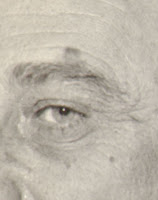
The photos below are entirely consistent with that scenario. The first was taken on January 30th 1935 and shows only the scar that had been seen on photos for at least twenty years and probably comes from the childhood incident described by Geoffrey Ward that occurred in early childhood.
The second photo, taken 14 months later is dramatically different, with an entirely new scar in the eyebrow directly below the lesion. Remember, any notion of a malignancy by the public and FDR's political career is over. This dates back prior to the second term! Quite clearly the lesion was cosmetically removed beginning in mid to late 1940 (see the cover of the book that has a photo from mid-August 1940). By Pearl Harbor it was gone, with absolutely no other explanation other than staged surgical removal.



According to Dr. Ruben Oropeza, Dr. George Packs's closest protegee and an exceedingly valuable source of information, Pack was following FDR for a "Hutchinson's Melanotic Freckle" for ten years prior to his death and personally performed two operations on FDR, the first being a local excision, and the second, a much later "open and close" laparotomy with Frank Lahey and Isodore Ravdin.
The photos below are entirely consistent with that scenario. The first was taken on January 30th 1935 and shows only the scar that had been seen on photos for at least twenty years and probably comes from the childhood incident described by Geoffrey Ward that occurred in early childhood.
The second photo, taken 14 months later is dramatically different, with an entirely new scar in the eyebrow directly below the lesion. Remember, any notion of a malignancy by the public and FDR's political career is over. This dates back prior to the second term! Quite clearly the lesion was cosmetically removed beginning in mid to late 1940 (see the cover of the book that has a photo from mid-August 1940). By Pearl Harbor it was gone, with absolutely no other explanation other than staged surgical removal.


Pretty impressive, huh?
I'll be shortly off to the FDRL yet again to comb through all of the 1935 photographs and FDR's daily schedule to try to determine with greater accuracy when the first operation took place. Obviously, more to follow.
FDR's battle with his health was sooooooooooo different than has been portrayed and had a tangible and previously unappreciated effect on many of his political decisions.
The paperback edition of our book is to released in two weeks. My paper in NEUROLOGY on FDR's epilepsy will appear on February 15th (I'll post a link to it on the blog after it is released).
Season's Greetings to all.
SL
Tuesday, November 2, 2010
Could It Happen Again? George W. Bush
I am often asked whether a cover-up of presidential health on the scale of FDR could occur again.
Judge for yourself.
Here is a link to a webpage that makes a strong argument that George W. Bush was wearing a portiable defibrillator during his presidency.
http://houston.indymedia.org/news/2004/12/35839.php
Here's yet another, far more convincing photo.
A similar bump was seen under his jacket at his recent appearance at the world series.

Judge for yourself.
Here is a link to a webpage that makes a strong argument that George W. Bush was wearing a portiable defibrillator during his presidency.
http://houston.indymedia.org/news/2004/12/35839.php
Here's yet another, far more convincing photo.
A similar bump was seen under his jacket at his recent appearance at the world series.

Thursday, October 28, 2010
Upcoming Events
1) Release of the paperback of our book in January 2011
2) January 5, 2011. Medical Grand Rounds at Robert Wood Johnson University Hospital, New Brunswick, NJ
"A Cancer on the Presidency, The Medical History of Franklin Delano Roosevelt"
3) Publication (approved but exact date pending) of my paper entitled "The Epilepsy of Franklin Delano Roosevelt" in the prestigious journal Neurology.
4) April 9, 2011. My co-author and I will share the podium at the Lahey Clinic in Boston with Dr. Harry Goldsmith for a comprehensive discussion of the health of FDR.
Changing long-standing historical misperceptions is an agonizingly slow process, especially since they go direct against the very powerful desire of the most important historical figure of the twentieth century!
2) January 5, 2011. Medical Grand Rounds at Robert Wood Johnson University Hospital, New Brunswick, NJ
"A Cancer on the Presidency, The Medical History of Franklin Delano Roosevelt"
3) Publication (approved but exact date pending) of my paper entitled "The Epilepsy of Franklin Delano Roosevelt" in the prestigious journal Neurology.
4) April 9, 2011. My co-author and I will share the podium at the Lahey Clinic in Boston with Dr. Harry Goldsmith for a comprehensive discussion of the health of FDR.
Changing long-standing historical misperceptions is an agonizingly slow process, especially since they go direct against the very powerful desire of the most important historical figure of the twentieth century!
Wednesday, October 27, 2010
More on the Truth of the Lucy Mercer Affair


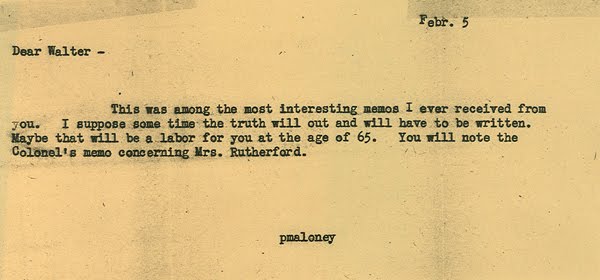
Here is a definitive document obtained from the Trohan papers at the Hoover Library in Iowa.
It pretty much tells it the way it really was. The famous incident of Eleanor finding the letters in the suitcase upon FDR's return from France was not the first time she was confronted with the affair. The great Geoffrey Ward agrees with this version.
Wednesday, October 20, 2010
Howard Bruenn and the Lahey Memorandum
On January 30, 1990 Jan Herman the medical historian of the Navy, interviewed Howard Bruenn at his summer home in Maine. Jan has kindly supplied me with the complete transcript of that most interesting encounter. It was, in retrospect, an interesting work of manipulative fiction on the part of Bruenn.
An excerpt:
Q: (Dr. Harry) Goldsmith reiterates your 1970 findings, but then steps off from there and talks about the President having cancer. He also brings up the subject of Dr. Lahey.
A: Lahey, at the only meeting we had following my initial examination [in March 1944], said, "This is nothing in my field." and signed himself off.
Q: Lahey really didn't have anything to do with the President's care after that?
Oh, no, not a bit. To my knowledge, he never saw him again. Dr. Paullin, some time after the President died, wanted me to give him my notes, but I didn't give them to him. I was afraid that he might do what Lord Moran [Churchill: Taken From the Diaries of Lord Moran, Houghton Mifflin Co., Boston, 1966] did to Churchill. He went into some pretty personal things and did himself and Mr. Churchill no good. I can tell you Churchill was very fond of his scotch and so on, but that had nothing to do with history.
Q: Back to the cancer, Goldsmith went into this thing about the mysterious pigmentation above the President's left eyebrow. He says there's a photograph that was taken much later in which the pigmentation is missing.
A: That's a photograph error or something. He never had anything wrong with that. He had something on top of his head, something benign. A doctor named Winchell, a surgeon from Mayo, took it off at Bethesda, no problem. (What Bruenn was referring to here was actually neurosurgeon Winchell Craig, who assisted George Webster to remove a benign epidermoid cyst from the back of FDR's head in February 1944. Webster or Craig never removed anything from FDR's face. By this time the lesion above the left eye was long gone, having been cosmetically removed between mid 1940 and late 1941. sl) 
An excerpt:
Q: (Dr. Harry) Goldsmith reiterates your 1970 findings, but then steps off from there and talks about the President having cancer. He also brings up the subject of Dr. Lahey.
A: Lahey, at the only meeting we had following my initial examination [in March 1944], said, "This is nothing in my field." and signed himself off.
Q: Lahey really didn't have anything to do with the President's care after that?
Oh, no, not a bit. To my knowledge, he never saw him again. Dr. Paullin, some time after the President died, wanted me to give him my notes, but I didn't give them to him. I was afraid that he might do what Lord Moran [Churchill: Taken From the Diaries of Lord Moran, Houghton Mifflin Co., Boston, 1966] did to Churchill. He went into some pretty personal things and did himself and Mr. Churchill no good. I can tell you Churchill was very fond of his scotch and so on, but that had nothing to do with history.
Q: Back to the cancer, Goldsmith went into this thing about the mysterious pigmentation above the President's left eyebrow. He says there's a photograph that was taken much later in which the pigmentation is missing.
A: That's a photograph error or something. He never had anything wrong with that. He had something on top of his head, something benign. A doctor named Winchell, a surgeon from Mayo, took it off at Bethesda, no problem. (What Bruenn was referring to here was actually neurosurgeon Winchell Craig, who assisted George Webster to remove a benign epidermoid cyst from the back of FDR's head in February 1944. Webster or Craig never removed anything from FDR's face. By this time the lesion above the left eye was long gone, having been cosmetically removed between mid 1940 and late 1941. sl)
In his 1970 paper for Annals of Internal Medicine (aka"The Gospel According to Bruenn), The eminent cardiologist describes Dr. Lahey's impression after examining FDR for the first and only time. Here are Bruenn's handwritten notes, allegedly written at the time , that appear verbatim in his paper:

(click on image to enlarge)
The Lahey memorandum quite clearly states that in July 1944, Lahey informed Admiral McIntire that after again examining the president, he determined that he would not survive a fourth term. McIntire then informed Roosevelt of the prognosis.
The greatest abdominal surgeon of his day quite cryptically opined that a cardiac problem would inevitably return and bring about FDR's demise.
The memorandum was only to be released if Dr. Lahey's reputation subsequently came under criticism for "allowing" FDR to run when terminally ill.
Why then did Bruenn include Lahey's concerns about the abdomen in his 1970 paper, especially when the entire thrust of the article was to promote the notion of a purely cardiovascular death?
The answer is quite clear: Bruenn was quite aware of the memorandum in 1970 and inserted this language to protect Lahey and specifically reduce the probability that the memorandum would be released.
In fact, the intentional deception can be carried even further: The 1970 paper was written in such a manner that if the Lahey Memorandum ever became public, it would consistent with Bruenn's treatise and not expose him as a participant in the cover-up. Clever indeed, and to this day, quite successful in its purpose.
Oh! What a tangled web we weave!
On the face of it, this all might seem quite conspiratorial, yet four years of watching this unfold tells me that it is indeed the case.
Last Wednesday I attended a well prepared and well received lecture at the Lahey Clinic by Dr. David Steinberg, whereupon the eminent director of the ethics returned a facsimile of the memorandum to the clinic. Among others, James Roosevelt Jr., the oldest son of FDR's oldest son, and a major executive in the administration of the Lahey Clinic was in attendance. While it was not the appropriate forum to address the above controversies about the memorandum, it did raise some very valid and interesting questions that will hopefully be dealt with in the near future.
My sincere thanks to Doctors Steinberg and Phil Kousoubris for their hospitality and courtesy.
Saturday, October 9, 2010
And Nobody Read It....

I just bought this newspaper, the April 13, 1945 Chicago Tribune, on Ebay for $25. I was the only bidder. It is one of countless newspapers reporting the death of President Franklin Delano Roosevelt but this one contains a little different information than all the others. 

Just below the picture of the new President Truman on the front page appears an article by Walter Trohan (no byline but most definitely Trohan) entitled "President's Health Failed Steadily Since Late '43".


(double click on the article to enlarge it)
The article reports that Howard Gerald Bruenn, a cardiologist, was commissioned into the Navy in late 1942 and was almost constantly with FDR since he was commissioned. It also discusses a "parade of doctors" that had been seeing FDR and that he was told in the Summer of 1944 that he had six months to live (as confirmed in the Lahey memorandum). It also mentions that an operation for cancer was anticipated by Dr. Lahey but he later determined it was "too late." The doctor mentioned who "refused to operate" was William Calhoun Stirling.
This is not at all the picture painted by Bruenn in 1970 of the gallant leader struck "out of the blue" by an unexpected brain hemorrhage. In his paper Bruenn clearly asserts that he saw the FDR for the first time in March 1944.
The widely circulated Tribune laid out a story that was largely accurate the day after FDR died. For the most part- either nobody read it or nobody cared!
In 2010 we have finally brought the true story of FDR's Deadly Secret back to the front pages of America. Perhaps this time it will be believed!
Friday, September 17, 2010
A Page From FDR's Calendar
At the FDR library there is a database that can be easily accessed that records FDR's activities each day of his presidency. It is taken from a number of sources, primarily the White House Usher's diary.

If one searches under the key word "doctor", a remarkable record comes out. Virtually every day FDR is in Washington from late 1938 to 1945, ther is a record to document a protracted visit to the doctors office. The cover story is that he had been seeing presidential physician Ross McIntire for "sinus" treatment. The reality is likely quite a bit different and related to his panoply of other unadmitted medical problems.
Visits to the hospital clearly documented on laboratory slips are not reflected in the diary. Just another of the many layers of cover-up of the extensive amount of medical treatment FDR received. Treatment that occupied a large and previously unappreciated portion of his life.
Just one page of dozens for your perusal.

Thursday, September 16, 2010
A Photo on Ebay

This photo is presently for sale on Ebay. See for yourself. How long will it take before the world accepts the fact that FDR had melanoma?
Sunday, September 5, 2010
A Curious Gruping of Signatures. 4 Roosevelts in Two!

I bought this for a pittance on eBay recently. It was advertised as an authentic signature of older FDR's half brother James Rossevelt "Rosy" Roosevelt (1854-1927), which indeed it is. Rosy was also the father of FDR's slightly older and somewhat strange and embarrasing half-nephew and short-lived Harvard Classmate Taddy, who may have been the nidus for the bitter disappointment of FDR not being named to the premier Harvard society, The Porcellanian.
The document in question is a fragment of a 1925 legal document, perhaps his will. The most interesting aspect of the document. wholly missed by the seller, was the witness, E.R. Roosevelt, none other than FDR's wife Eleanor Roosevelt Roosevelt. This is surely a more valuable signature than the one featured in the sale. It also completes the rather curious grouping of signatures with two Roosevelts in it!
I have been kindly invited to attend a lecture on October 18th at the Lahey Clinic concerning the Lahey Memorandum.The post-lecture Q and A should be most interesting! As I have said, FDR probably had a secret middle-of-the-night operation there for his metastatic cancer (open and close by all reports).
Friday, September 3, 2010
AStunning New Photograph Portrait ca.1920

I just purchased this magnificent close-up portrait of FDR on eBay.
I initially thought it was earlier but this Chicago Tribune file photo is clearly dated to the 1920 campaign and he is apparantly wearing the same suit and tie, leading to the conclusion that this portrait was airbrushed, considering the lack of the mole on the right cheek and lack of the scar on the lateral left eyebrow seen in earlier photos that probably came from the incident as a child described in Geoff Ward's Before the Trumpet. The pre-malignant melanoma still dates back to 1920.

Here is a pot-pourri of earlier pictures from various dates. As previosly noted, on the basis of these photographs, it would appear that FDR had some minor cosmetic work done about the time of the 1920 campaign.


Sunday, August 8, 2010
Wikileaks. Old News! See Amerasia Magazine

In early 1945, Amerasia Magazine published the title article above. It was a top secret document that had been purloined and leaked, most probably by John Stuart Service.
see:http://en.wikipedia.org/wiki/Amerasia
The FBI then raided the Amerasia offices and found a huge cache of top secret material. Unfortunately, the case against Service was botched and he never came to appropriate justice. In fact, he was reinstated and later wrote extensively in his own defense.
The notorious Joseph McCarthy used the Amerasia leak in his red-baiting rantings in the early 1950's.
A lot different than the current environment. The Amerasia leaks were quite similar in importance to those recently found on Wikileaks. Perhaps we've learned our lesson. Perhaps not!
Tuesday, August 3, 2010
The Grace Tully Papers
FDR has once again made the news with the "discovery" of the sequestered Grace Tully papers, the former archive of the disgraced FDR biographer Conrad Black, currently imprisoned. Black's excellent, exceedingly long volume was published by Public Affairs, the same house that published our book.
Hightlights of the "new" material include a letter to FDR from Mussolini, a nice letter from Joseph Kennedy and a letter expressing great concern for FDR's health by Lucy Rutherford, in which she arranges her last visit to Warm Springs.
It is no secret that Tully knew about Lucy. In fact she mentioned her neing in Warm Springs in 1948 and no one picked up on its significance. The Chicago Tribune knew about Lucy's presence in 1948 and sat on the story until Jonathan Daniels' 1966 article in LIFE.
I don't expect anything significant in the remainder of the archive with respect to FDR's health though it will be fun to go over some fresh material. We are quite correct in our book about the reality of the situation and it will take a while until it sinks in so that mainstream historians come on board. It will happen- just a matter of time. No credible medical professional has yet to puch a hole on our thesis.
FDR most probably died of a brain hemorrhage into a metaststic melanoma- period.
This blogger would be most receptive to presenting a personal lecture at any academic venue.
Yours in history,
SL
Hightlights of the "new" material include a letter to FDR from Mussolini, a nice letter from Joseph Kennedy and a letter expressing great concern for FDR's health by Lucy Rutherford, in which she arranges her last visit to Warm Springs.
It is no secret that Tully knew about Lucy. In fact she mentioned her neing in Warm Springs in 1948 and no one picked up on its significance. The Chicago Tribune knew about Lucy's presence in 1948 and sat on the story until Jonathan Daniels' 1966 article in LIFE.
I don't expect anything significant in the remainder of the archive with respect to FDR's health though it will be fun to go over some fresh material. We are quite correct in our book about the reality of the situation and it will take a while until it sinks in so that mainstream historians come on board. It will happen- just a matter of time. No credible medical professional has yet to puch a hole on our thesis.
FDR most probably died of a brain hemorrhage into a metaststic melanoma- period.
This blogger would be most receptive to presenting a personal lecture at any academic venue.
Yours in history,
SL
Saturday, June 26, 2010
The Top Ten Disgraced American Military Leaders. Stanley McChrystal
The world loves lists. This one seems appropriate in view of the recent fracas over General Stanley McChrystal. I'd love to hear comments and suggestions for additions. Thanks!
In view of the recent highly-publicized firing of General Stanley McChrystal, I offer my retrospective list of the top ten American disgraced military leaders (in descending order).
1) Benedict Arnold
Arnold is the epitome of the word “traitor, the first in American history and by virtue of the fact that he actually led battles against his former country must head the list as the number one all-time disgraced military leader.
2) Douglas MacArthur
MacArthur’s greatness as a World War II general, career military officer and rehabilitator of Japan is unquestioned. His highly publicized recall by President Harry Truman for insubordinate behavior in Korea, nearly bringing about World War III with China, ranks as the greatest act of outright defiance of an American president.
3) George B. McClellan
The legendary firing of George McClellan by President Abraham Lincoln for failure to press the Confederacy is one of the defining moments of the Civil War. He was replaced by the bumbling and incompetent Ambrose Burnside, himself soon removed in favor of Joseph Hooker. Unsuccessfully ran for President against Lincoln in 1864.
4) Curtis Lemay
Another brilliant career officer. The orchestrator of B-29 incendiary bombing of Japan during World War II and subsequently fortified the Strategic Air Command. During the Cuban Missile Crisis in 1962, after the Soviets turned back he urged President Kennedy to bomb Cuba. Fortunately, he was overruled and a nuclear holocaust was averted. It was later revealed that the Russians had and were authorized to use tactical nuclear weapons in the event of invasion. After retiring from the military in 1968 he further reduced his credibility as the vice-presidential candidate of segregationist George Wallace.
5) William Hull
After fighting in American Revolutionary campaigns in Connecticut, New York, and New Jersey, in 1805 he was appointed governor of Michigan Territory. At the outbreak of the War of 1812, he was appointed brigadier general and charged with defending Michigan and attacking Canada. His poorly planned invasion of Canada forced him to retreat to Detroit, where he surrendered without a fight. He was court-martialed and convicted of cowardice and neglect of duty. His death sentence was remitted by President James Madison because of his earlier service.
6) Joseph Stilwell
A brilliant field commander and beloved leader during WW II, he nearly lost China to the Japanese while vainly campaigning in Burma and his “Vinegar” personality later so incensed Chiang Kai-shek that he threatened to make peace with the Japanese that would have mobilized over a million troops against our forces in the Pacific. He was recalled by President Franklin Roosevelt and replaced by the more diplomatic Albert C. Wedemeyer.
7) George Patton
The swashbuckling and brilliant field commander who nearly lost his command and was soundly and publicly disciplined by Dwight Eisenhower after slapping a shell-shocking soldier on August 3, 1943.
8) George McChrystal
9) George Casey/John Abizaid
Both men were fired in early 2007 by President George W. Bush in a “clean sweep” of the military leadership of the Iraqi war. They publicly opposed the buildup of troops on the grounds that it could delay "the development of Iraqi security forces and increase anger at the United States in the Arab world." Replaced by Admiral William J. Fallon.
10) Thomas Algeo Rowley
While commander of a division at the Battle of Gettysburg on July 1, 1863, the brigade suffered heavy casualties confronting Confederates and he was thrown from his horse during the retreat. Following a confrontation with Brigadier General Lysander Cutler, he was removed for drunkenness and disobeying orders. Convicted by a court martial, he was reinstated by order of Secretary of War Stanton only to resign on December 29, 1964 after not being re-assigned to a field command.
Dishonorable mention: General Ricardo Sanchez (Abu Gharaib). Lieutenant William Calley (My Lai)
In view of the recent highly-publicized firing of General Stanley McChrystal, I offer my retrospective list of the top ten American disgraced military leaders (in descending order).
1) Benedict Arnold
Arnold is the epitome of the word “traitor, the first in American history and by virtue of the fact that he actually led battles against his former country must head the list as the number one all-time disgraced military leader.
2) Douglas MacArthur
MacArthur’s greatness as a World War II general, career military officer and rehabilitator of Japan is unquestioned. His highly publicized recall by President Harry Truman for insubordinate behavior in Korea, nearly bringing about World War III with China, ranks as the greatest act of outright defiance of an American president.
3) George B. McClellan
The legendary firing of George McClellan by President Abraham Lincoln for failure to press the Confederacy is one of the defining moments of the Civil War. He was replaced by the bumbling and incompetent Ambrose Burnside, himself soon removed in favor of Joseph Hooker. Unsuccessfully ran for President against Lincoln in 1864.
4) Curtis Lemay
Another brilliant career officer. The orchestrator of B-29 incendiary bombing of Japan during World War II and subsequently fortified the Strategic Air Command. During the Cuban Missile Crisis in 1962, after the Soviets turned back he urged President Kennedy to bomb Cuba. Fortunately, he was overruled and a nuclear holocaust was averted. It was later revealed that the Russians had and were authorized to use tactical nuclear weapons in the event of invasion. After retiring from the military in 1968 he further reduced his credibility as the vice-presidential candidate of segregationist George Wallace.
5) William Hull
After fighting in American Revolutionary campaigns in Connecticut, New York, and New Jersey, in 1805 he was appointed governor of Michigan Territory. At the outbreak of the War of 1812, he was appointed brigadier general and charged with defending Michigan and attacking Canada. His poorly planned invasion of Canada forced him to retreat to Detroit, where he surrendered without a fight. He was court-martialed and convicted of cowardice and neglect of duty. His death sentence was remitted by President James Madison because of his earlier service.
6) Joseph Stilwell
A brilliant field commander and beloved leader during WW II, he nearly lost China to the Japanese while vainly campaigning in Burma and his “Vinegar” personality later so incensed Chiang Kai-shek that he threatened to make peace with the Japanese that would have mobilized over a million troops against our forces in the Pacific. He was recalled by President Franklin Roosevelt and replaced by the more diplomatic Albert C. Wedemeyer.
7) George Patton
The swashbuckling and brilliant field commander who nearly lost his command and was soundly and publicly disciplined by Dwight Eisenhower after slapping a shell-shocking soldier on August 3, 1943.
8) George McChrystal
9) George Casey/John Abizaid
Both men were fired in early 2007 by President George W. Bush in a “clean sweep” of the military leadership of the Iraqi war. They publicly opposed the buildup of troops on the grounds that it could delay "the development of Iraqi security forces and increase anger at the United States in the Arab world." Replaced by Admiral William J. Fallon.
10) Thomas Algeo Rowley
While commander of a division at the Battle of Gettysburg on July 1, 1863, the brigade suffered heavy casualties confronting Confederates and he was thrown from his horse during the retreat. Following a confrontation with Brigadier General Lysander Cutler, he was removed for drunkenness and disobeying orders. Convicted by a court martial, he was reinstated by order of Secretary of War Stanton only to resign on December 29, 1964 after not being re-assigned to a field command.
Dishonorable mention: General Ricardo Sanchez (Abu Gharaib). Lieutenant William Calley (My Lai)
Tuesday, June 22, 2010
Does anybody know Oliver Stone?
Just back from a "grand" time at the FDR Reading Festival at Hyde Park (as usual we were skipped over by book TV). Gave two lectures which were well received and signed about thirty books. The next event is the paperback edition in January.
Anyhow, I've been thinking that Oliver Stone would make a great movie of our book. A la "JFK" but this one really happened! Eventually the truth will be accepted. There's just too much evidence to ignore and an ever increasing body of legitimate historians are believers. It would nice, though, to get a bump from Hollywood. So if anyone knows Mr. Stone, please give him a heads up. For that matter, the same goes for the History Channel or HBO (they did a three part series in 1980 based on Jim Bishop's book, starring Jason Robards as FDR)
More new an interesting information to follow.
SL
Anyhow, I've been thinking that Oliver Stone would make a great movie of our book. A la "JFK" but this one really happened! Eventually the truth will be accepted. There's just too much evidence to ignore and an ever increasing body of legitimate historians are believers. It would nice, though, to get a bump from Hollywood. So if anyone knows Mr. Stone, please give him a heads up. For that matter, the same goes for the History Channel or HBO (they did a three part series in 1980 based on Jim Bishop's book, starring Jason Robards as FDR)
More new an interesting information to follow.
SL
Sunday, June 6, 2010
Rewriting History: Henry Wadsworth Longfellow and Howard Gerald Bruenn.
Over and over, we find instances of how the written word changed or redefined a historical event. Perhaps the most quoted example, the epitome of Yellow Journalism, the “I’ll furnish the war” telegrams between William Randolph Hearst and Frederick Remington, are themselves open to dispute by W. Joseph Campbell. In his Summer 2000 article in Journalism and Mass Communication Quarterly, Campbell presents a well-documented and convincing argument that the communications, as reported by the sole source of the anecdote, James Creelman, were never sent.
It is undisputable is that the pen has had a remarkable and long-standing influence on the way history is perceived. No better example is the legacy of Paul Revere as defined by Henry Wadsworth Longfellow, in his epic poem, “Paul Revere’s Ride” in the January 1861 issue of the venerable Atlantic Monthly. Prior to the poem, Revere was best remembered as a silversmith and engraver. After 1861, he rose to the iconic status he enjoys today as one of the major heroes of the American Revolution. Longfellow had the specific intention of creating a legend and, as the most “revered” poet of the age, his words were exceedingly successful to that end.
Over the years, historians have recognized that Longfellow’s account was, in great part, historical fiction and Revere’s role in the events of 1775 role have been taken in a more realistic perspective.
Intentional deceptions often take time to be realized and accepted and this is the case that I have been persistently making about the 1970 paper in Annals of Internal Medicine by Doctor Howard Gerald Bruenn entitled “Clinical Notes on the Illness and Death of President Franklin D. Roosevelt. “ Bruenn wrote that paper with very much the same intent as Longfellow- to redefine how the world thought about his mentor and patient. He had a great teacher. “The Juggler” Roosevelt practiced deception as religion. His masterful manipulation of the press projected a lasting and powerful impression on the vast majority of the American people of an image that often did not exist. Yet, if it was not reported, it virtually never happened.
The intentions of Bruenn’s 1970 paper are laid out in the accompanying editorial . “We are given, by Dr. Bruenn, the picture of a great and gallant man, fatigued by the burdens of his office and by his hypertension and reduced cardiac reserve, yet quite able to exercise his judgment and to use the fruits of his unique knowledge and experience in guiding the war effort.”
Twenty-five years after Roosevelt’s death, Bruenn’s paper set the standard for every subsequent historical account of Roosevelt’s life. The myths he perpetrated, the twentieth century equivalent of Longfellow’s “one if by land and two if by sea” remain, for the most part, unscathed.
Roosevelt didn’t care about his health and was never informed of his diagnosis? He remained mentally clear until the moment he died? The presidential physicians were incompetent and made false statements to cover their own shortcomings? All unadulterated poppycock!
If Longfellow had wrote it might have read this way:
Read on my children and you shall see
Of the health and the greatness of Franklin D.
His heart was sick, but his mind was clear
Free to inspire a freedom from fear
He led the nation through depression and war
With a pressure of blood that continued to soar.
His docs kept him going the best they could
Though they would not tell him that all was not good.
He lost forty pounds, his doctors aghast
“I like my flat tummy” he said when they asked
There were no strokes. There was no cancer
A bad circulation was the only answer.
He led us with vigor till the day he died
Out of the blue in April forty-five.
It is undisputable is that the pen has had a remarkable and long-standing influence on the way history is perceived. No better example is the legacy of Paul Revere as defined by Henry Wadsworth Longfellow, in his epic poem, “Paul Revere’s Ride” in the January 1861 issue of the venerable Atlantic Monthly. Prior to the poem, Revere was best remembered as a silversmith and engraver. After 1861, he rose to the iconic status he enjoys today as one of the major heroes of the American Revolution. Longfellow had the specific intention of creating a legend and, as the most “revered” poet of the age, his words were exceedingly successful to that end.
Over the years, historians have recognized that Longfellow’s account was, in great part, historical fiction and Revere’s role in the events of 1775 role have been taken in a more realistic perspective.
Intentional deceptions often take time to be realized and accepted and this is the case that I have been persistently making about the 1970 paper in Annals of Internal Medicine by Doctor Howard Gerald Bruenn entitled “Clinical Notes on the Illness and Death of President Franklin D. Roosevelt. “ Bruenn wrote that paper with very much the same intent as Longfellow- to redefine how the world thought about his mentor and patient. He had a great teacher. “The Juggler” Roosevelt practiced deception as religion. His masterful manipulation of the press projected a lasting and powerful impression on the vast majority of the American people of an image that often did not exist. Yet, if it was not reported, it virtually never happened.
The intentions of Bruenn’s 1970 paper are laid out in the accompanying editorial . “We are given, by Dr. Bruenn, the picture of a great and gallant man, fatigued by the burdens of his office and by his hypertension and reduced cardiac reserve, yet quite able to exercise his judgment and to use the fruits of his unique knowledge and experience in guiding the war effort.”
Twenty-five years after Roosevelt’s death, Bruenn’s paper set the standard for every subsequent historical account of Roosevelt’s life. The myths he perpetrated, the twentieth century equivalent of Longfellow’s “one if by land and two if by sea” remain, for the most part, unscathed.
Roosevelt didn’t care about his health and was never informed of his diagnosis? He remained mentally clear until the moment he died? The presidential physicians were incompetent and made false statements to cover their own shortcomings? All unadulterated poppycock!
If Longfellow had wrote it might have read this way:
Read on my children and you shall see
Of the health and the greatness of Franklin D.
His heart was sick, but his mind was clear
Free to inspire a freedom from fear
He led the nation through depression and war
With a pressure of blood that continued to soar.
His docs kept him going the best they could
Though they would not tell him that all was not good.
He lost forty pounds, his doctors aghast
“I like my flat tummy” he said when they asked
There were no strokes. There was no cancer
A bad circulation was the only answer.
He led us with vigor till the day he died
Out of the blue in April forty-five.
Monday, May 24, 2010
The Sick Man at Yalta

My article on the historical implications of FDR's health at Yalta and afterwards is presently on History News Network.
http://www.hnn.us/articles/126978.html
Subscribe to:
Posts (Atom)



 Posts
Posts

